Framed vs Frameless Cabinet Math
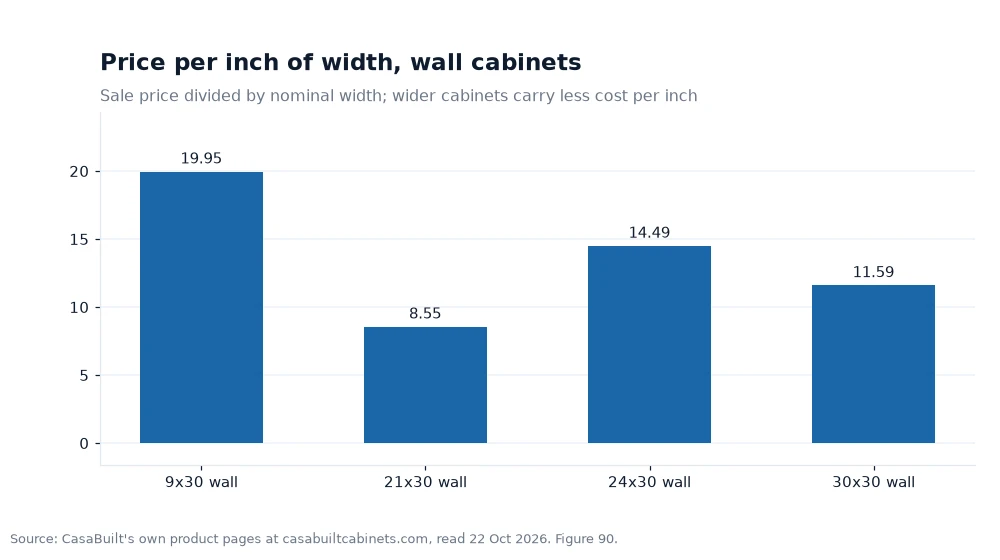
A face frame costs 1-1/2 inches of opening on each side, so a 21-inch framed wall cabinet gives 18 inches of clear space and the frameless version of the same box gives 20, an 11% gain for the same footprint. The money side is stranger: a 30-inch-high wall cabinet sells for $179.54 at 21 inches wide and $347.76 at 24 inches wide, or $8.55 and $14.49 per inch of width.
Key takeaways
- The published face frame is 3/4 by 1-1/2 inches, so a framed opening loses 3 inches of nominal width.
- A frameless box gives back roughly 2 inches of that, because only the 1/2-inch side panels sit inside the width.
- Narrow cabinets gain the most: a 9-inch box goes from a 6-inch to an 8-inch opening, a 33% increase.
- Price per inch falls as boxes get wider until a second door is added, then it climbs again.
The three inches a face frame removes
CasaBuilt publishes its frame as 3/4 inch by 1-1/2 inch solid birch. The 1-1/2 inch face is the part that matters here, because it runs vertically down both sides of every opening. Add the two sides and 3 inches of the nominal width is frame rather than usable space. A 24-inch cabinet becomes a 21-inch opening. A 9-inch cabinet becomes 6 inches, which is fine for spice jars and awkward for anything wider.
Frameless construction deletes that rail. The door sits on top of the box instead of inside a frame, and the only material between the nominal width and the clear opening is the box panel. CasaBuilt lists that panel at 1/2 inch, so the loss is about 1 inch across the cabinet rather than 3. On the same 24-inch box the clear opening moves from 21 inches to 23.
The frame is 3 inches of width you pay for but cannot put a plate in. Whether that trade is worth it depends on the cabinet, not on the construction method in general.
Price per inch is not price per cabinet
Divide the published sale price by the nominal width and the catalog stops looking like a price ladder. Of the four widths in the chart, the 9-inch wall cabinet is the most expensive per inch at $19.95 and the 21-inch is the cheapest at $8.55. That is a 2.3-fold spread between two boxes that share a height, a depth and a door count.
| Nominal width | Sale price | Price per inch | Framed opening | Frameless opening |
|---|---|---|---|---|
| 9 in | $179.54 | $19.95 | 6 in | 8 in |
| 21 in | $179.54 | $8.55 | 18 in | 20 in |
| 24 in | $347.76 | $14.49 | 21 in | 23 in |
| 30 in | $347.76 | $11.59 | 27 in | 29 in |
The pattern comes from fixed parts. A single-door cabinet carries one door, one hinge pair and one handle whether it is 9 inches wide or 21 inches wide, so the 9-inch box spreads the same hardware over less than half the width. At 24 inches a second door, a second hinge pair and a second handle arrive, and the price jumps by $168.22 even though the cabinet is only 3 inches wider. Then the 30-inch spreads those same two doors over 6 more inches and the rate drops to $11.59.
So a quote comparison at one width tells you almost nothing about the next width. Two lines can be level at one width and far apart at the next, because the door count changes at different points in each catalog.
Drawer access follows the same arithmetic
Base cabinets live or die on drawer width. CasaBuilt's base line runs from 9 to 42 inches wide at 34-1/2 inches high and 24 inches deep, and the drawers are 5/8-inch rubberwood with dovetail joints. In a framed box the drawer box has to pass through the frame opening, so the drawer is sized to the opening rather than to the cabinet. A 24-inch framed base gives a 21-inch opening and a drawer box a little under that. Remove the frame and the same cabinet accepts a drawer box closer to 23 inches.
Two inches of drawer width sounds trivial until you translate it into what a drawer holds. A box in a 21-inch framed opening gets 18 inches of glide length and about 20 inches of clear tray. The frameless box keeps those same 18-inch glides and adds 2 inches of clear width beside them, which is the difference between a cutlery tray that rattles and one that sits still.
Narrow cabinets show the gain most clearly: a 9-inch frameless base keeps 8 inches of interior width against 6 for the framed version, a third more room in a box built for spice jars and cutting boards.
The line CasaBuilt lists as frameless rta kitchen cabinets is small, which is worth knowing before you design around it. The frameless door sits flat over the box and the reveal between doors is a design decision rather than a byproduct of frame width.
Where the frame still earns its keep
Frameless is not automatically better, and the arithmetic above is deliberately narrow. A face frame gives hinges a 1-1/2-inch solid birch surface to bite into and it covers the joint where two boxes meet. On a wall that is out of plumb, the frame hides a small step between cabinets that a frameless run shows as a shadow line.
A framed kitchen also tolerates a slightly less careful installation. Each box can be shimmed independently and the frames still read as one plane, because the eye follows the rail rather than the door edge. Frameless boxes have to be aligned to each other within a fraction of an inch, since the full-overlay door exposes the box edge directly and any step shows.
For a DIY install in an older house, that difference is real labor. For a straight wall in a new build, it is close to irrelevant and the extra opening wins. Either way, check the wall before you choose, because a run that is out of level will show at the door edges. The site's published measurement guide covers the checks worth making first.
Worked example
The chart lists four wall cabinets at $19.95, $8.55, $14.49 and $11.59 per inch of width. Multiply each rate back by its nominal width to recover the published price. The 9-inch: $19.95 times 9 equals $179.55, against a listed $179.54, a rounding difference of one cent. The 21-inch: $8.55 times 21 equals $179.55, also one cent above the list. The 24-inch: $14.49 times 24 equals $347.76 exactly. The 30-inch: $11.59 times 30 equals $347.70, six cents under the $347.76 list. The chart is therefore a division of the same two sale prices, not a separate price list.
Now price a 90-inch wall run two ways. Three 30-inch double-door cabinets cover 90 inches and cost 3 times $347.76, or $1,043.28, which is $11.59 per inch. Five 21-inch single-door cabinets cover 105 inches and cost 5 times $179.54, or $897.70. Trim the run to the 90 inches you actually have and the cost per usable inch is $897.70 divided by 90, or $9.97. The single-door route is $145.58 cheaper and $1.62 per inch cheaper, but it buys 15 inches of cabinet you have to cut off with filler or absorb into the layout.
Finally, the opening. A 21-inch framed box clears 18 inches and the frameless version clears 20, so 20 divided by 18 is 1.111, an 11% gain. The 9-inch goes from 6 to 8, which is 1.333, a 33% gain. The 30-inch goes from 27 to 29, which is 1.074, a 7% gain. Frameless pays best on the smallest boxes and barely matters on the largest.
Frequently asked questions
Is frameless construction cheaper than framed?
Not by rule. CasaBuilt prices each style as a finished product, so the comparison that matters is between two specific widths on two specific style pages. Use price per inch rather than the cabinet total, and check whether the wider box in the comparison carries one door or two, because that single change moves the rate by several dollars.
Does removing the face frame make the cabinet weaker?
The published box is 1/2-inch birch plywood in both constructions, so the frameless version is the same box without the 3/4 by 1-1/2-inch birch rail on the front edge. The rail stiffens the face and gives hinges a solid mounting surface. A frameless box relies on the panel itself and on careful alignment between cabinets.
How much wider is a frameless drawer?
About 2 inches on a 24-inch base, because the drawer is sized to the clear opening. Take the nominal width, subtract 3 inches for a framed opening, or about 1 inch for a frameless opening, and compare the results before you decide where the pull-outs go.
Measure the opening, not the cabinet
Pick the three widths your layout actually needs, write down the price per inch for each, and tape the framed opening on the wall with painter's tape. Stand back and look at the gap between the tape edges. If the 9-inch box is part of the plan, that gap is the whole decision, because 6 inches and 8 inches behave like different cabinets. Order a sample door in the finish you are considering and hold it against the tape before the order goes in.
Figures quoted here come from the manufacturer's own website, read 22 Oct 2026[1].